 English

Reading Time: 7 minutes
Converting liquid and oil-based ingredients into powders can simplify formulation development for dietary supplements, oral pharmaceuticals and dermatological products. Ingredients such as vitamin E, retinol and other oils may require a carrier before they can be incorporated into dry blends, capsules or other powder-based formulations.
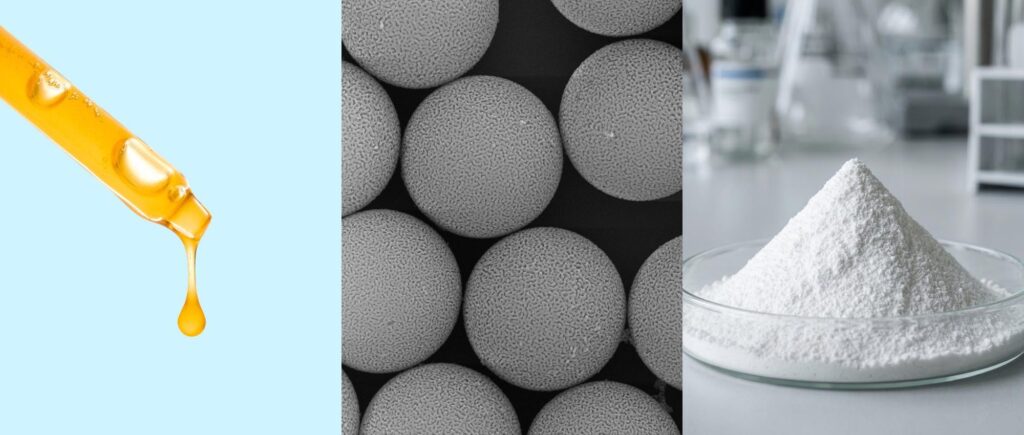
RESIFA™ SOLESPHERE™ porous silica are uniform spherical particles with high oil absorption and a range of pore structures and particle sizes. These properties allow formulation scientists to evaluate different grades for liquid loading, powder handling and ingredient release characteristics.
What Is Porous Silica and How Is It Used as an Excipient?
Porous silica are small particles containing an interconnected network of pores. These pores provide internal surface area and volume that can accommodate liquid ingredients.
In pharmaceutical and nutraceutical formulations, silica can function as an excipient—an ingredient added to support the formulation, processing or delivery of active ingredients.
Excipients can perform functions beyond adding volume to a product; they can also serve as carriers, fillers, processing aids or agents that influence powder handling and ingredient release.
SOLESPHERE high-purity silica has a uniform spherical shape and is available in particle sizes ranging from 3 to 20 micrometers. Different grades provide different pore structures and absorption characteristics, enabling product developers to evaluate grades for specific formulation requirements.
How Does Porous Silica Convert Liquids into Powders?
Liquid-to-powder conversion involves combining a liquid ingredient with a porous carrier that can accommodate the liquid within its pore structure.
When a compatible oil or liquid is mixed with porous silica at an appropriate ratio, the liquid is absorbed into the particles, retaining a powder-like form suitable for additional processing.
This approach is particularly relevant to ingredients that are difficult to incorporate directly into dry formulations such as:
- Dietary supplements: Converting oil-based vitamins and other liquid nutritional ingredients into powders for further formulation.
- Oral pharmaceuticals: Incorporating liquid drug ingredients into solid dosage forms.
- Dermatological products: Incorporating retinol and other oil-based ingredients into powder-based formulations.
For example, vitamin E oil can be loaded into porous silica to create a powder-like material. This provides an alternative starting point for formulators developing products that require dry ingredient handling.
The process is sometimes described as encapsulation. However, liquid loading into porous silica is not the same as protective microencapsulation or controlled release.
High Oil Absorption Supports Liquid-to-Powder Formulation
One of the main advantages of SOLESPHERE porous silica is its capacity to absorb substantial amounts of liquid relative to the amount of carrier used. This can be important when formulating products containing concentrated liquid ingredients.
SOLESPHERE grades have oil absorption capacities ranging from approximately 150 to 400 mL per 100 g of silica. SOLESPHERE H-53, for example, has the following properties:
| Property | SOLESPHERE H-53 |
| Oil absorption | 400 mL/100 g |
| Average particle size | 5 µm |
| Specific surface area | 700 m²/g |
| Pore volume | 2 mL/g |
SOLESPHERE H-53’s high pore volume and specific surface area provide substantial capacity for liquid loading. However, actual loading depends on the ingredient’s viscosity, polarity and composition, as well as mixing conditions and the desired powder characteristics.
How Can Porous Silica Support Ingredient Stability?
In addition to liquid loading, porous silica can be evaluated for its ability to support ingredient stability and moisture management during formulation and storage.
Some active ingredients are sensitive to moisture, light, oxygen or interactions with other formulation components. The selection of an appropriate excipient can influence how these ingredients behave within the finished product.
The porous structure and absorption characteristics of SOLESPHERE silica may help formulators manage liquid ingredients and reduce certain processing challenges associated with moisture or oil migration.
However, loading an ingredient into porous silica does not necessarily protect it from oxidation, ultraviolet exposure or chemical degradation. For sensitive ingredients such as retinol and certain vitamins, stability testing should assess the loaded material and the finished formulation under relevant storage conditions. Potential evaluation parameters include active-ingredient retention, moisture uptake, physical changes, oxidation and compatibility with other excipients.
How Does Silica Pore Structure Influence Ingredient Release?
Ingredient release is another consideration when selecting a porous silica carrier. Release kinetics describe the rate and pattern at which an ingredient is released from a carrier over time.
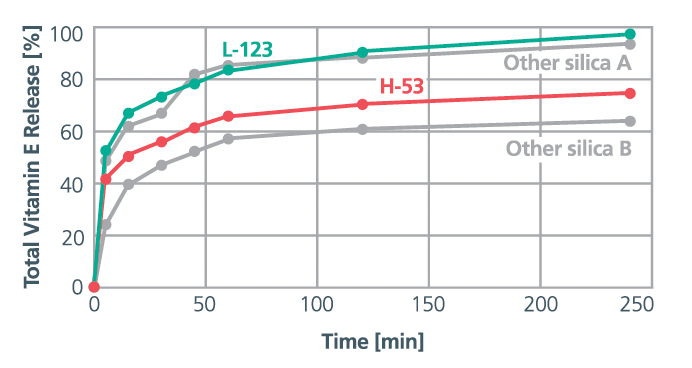
SOLESPHERE grades have different pore structures, providing formulation scientists with a way to investigate how silica selection influences release behavior. For example, a supplied vitamin E oil release study compared SOLESPHERE L-123 and H-53.
Under the study conditions, L-123 demonstrated a higher cumulative vitamin E release profile than H-53 at the measured time points after the start of the test. This difference illustrates how selecting a silica grade can influence ingredient release characteristics.
For product developers, grade selection may be one variable to consider when evaluating the desired release profile of an active ingredient. Other important factors include the properties of the loaded ingredient, the amount loaded, the release medium and the composition of the finished formulation.
The vitamin E testing results demonstrate differences under experimental conditions. They do not establish that either grade will provide a particular release profile in the gastrointestinal tract, on the skin or in a finished dosage form.
Vitamin E Release Rates of SOLESPHERE Silica Grades
Why are Spherical Silica Particles Used for Powder Handling and Processing?
Converting a liquid into a powder is only beneficial if the resulting material can be handled and processed effectively. Powder flow affects operations such as material transfer, blending, capsule filling and tablet manufacturing. Poor flow can complicate production and contribute to inconsistent material handling.
SOLESPHERE particles have a uniform spherical shape and relatively narrow particle size distributions, making it ideal for applications requiring predictable powder handling and processability.
Different particle sizes allow formulators to consider particle geometry alongside oil absorption and pore structure. However, flowability varies by grade. Larger silica particles generally exhibit better flowability because gravitational forces more readily overcome the cohesive forces between particles. A lower angle of repose indicates that the powder spreads more easily.
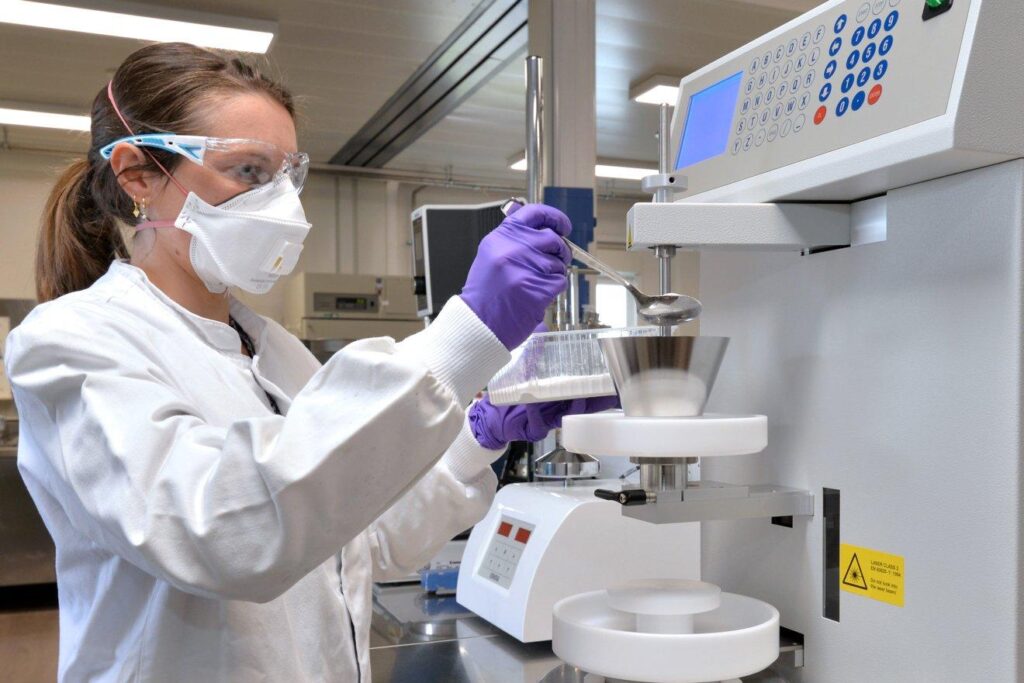
For example, measurements using a Hosokawa Micron Powder Characteristics Tester PT-R produced the following results:
| SOLESPHERE grade | Angle of repose |
| H-121 | 26.9° |
| H-122 | 31.5° |
| L-123 | 31.6° |
| H-31 | 42.4° |
| H-33 | 35.0° |
| H-53 | 50.4° |
However, flowability also depends on particle shape, surface characteristics and formulation conditions, making grade-specific testing important. Different SOLESPHERE grades exhibit different handling characteristics. A grade selected primarily for high oil absorption may not provide the best flowability for a particular process.
Liquid loading can also change powder behavior. Formulators should therefore evaluate flowability after the intended ingredient has been incorporated.
Potential Applications of Porous Silica in Healthcare Formulations
Porous silica can serve several excipient functions in pharmaceutical, nutraceutical and dermatological formulations. The most suitable SOLESPHERE grade depends on the ingredient’s properties, intended dosage form and processing requirements.
Dietary Supplements and Nutraceuticals
Oil-based vitamins and other liquid nutritional ingredients can present challenges when developing capsules, tablets and powdered supplements. Porous silica provides a carrier for these ingredients, allowing formulators to evaluate liquid loading while maintaining the powder characteristics needed for blending, filling and other manufacturing processes.
SOLESPHERE’s range of oil absorption capacities and particle sizes offers flexibility when balancing ingredient concentration, carrier requirements and powder handling.
Oral Pharmaceutical Formulations
In oral drug development, excipients influence manufacturability, ingredient stability and dosage-form performance. Porous silica can be evaluated as a carrier for compatible liquid drug ingredients in solid dosage formulations.
Different SOLESPHERE pore structures also allow scientists to investigate ingredient release characteristics. Grade selection should consider drug compatibility, processing conditions, stability, intended release behavior and applicable regulatory requirements.
Dermatological Formulations
Dermatological formulations may contain oil-based ingredients such as retinol that require careful consideration of stability, compatibility and processing. Porous silica can carry these ingredients for incorporation into powder-based formulations.
Particle size, oil absorption and pore structure may also influence texture, dispersion and handling characteristics. Formulators should evaluate the selected grade for compatibility with the active ingredient and the intended finished product.
SOLESPHERE has been used for many years as an ingredient of skincare, suncreen and cosmetic formulations to improve their texture and spreadability.
How to Select the Right Porous Silica Grade
Selecting a porous silica excipient involves balancing multiple material properties and formulation requirements.
Liquid-loading capacity: Determine how much of the intended ingredient can be loaded while maintaining the desired physical characteristics.
Pore structure and release behavior: Evaluate whether different silica grades produce meaningful differences in ingredient release under relevant test conditions.
Particle size and flowability: Consider how the selected grade performs during powder handling, blending, transfer and filling.
Ingredient stability: Test whether the carrier is compatible with the active ingredient and supports the required stability profile.
Processing requirements: Evaluate the loaded material using the intended mixing, filling or manufacturing process.
Regulatory suitability: Confirm that the selected grade, quality documentation and intended use meet the applicable requirements for the product category and market.
A grade that offers high oil absorption may differ from another grade in flowability or ingredient release. Testing multiple grades can help identify an appropriate balance of these characteristics.
Consider SOLESPHERE for Liquid-to-Powder Formulation Development
RESIFA SOLESPHERE porous silica offers formulation scientists a range of grades for evaluating liquid loading, ingredient release and powder handling in pharmaceutical, nutraceutical and dermatological applications.
Contact AGC Chemicals to discuss your liquid ingredient, target loading and processing requirements. Our technical team can help identify the most appropriate grades for evaluation in your specific application.
Frequently Asked Questions About Porous Silica Excipients
What is porous silica used for in pharmaceutical formulations?
Porous silica can function as an excipient for carrying liquid ingredients, supporting powder processing and evaluating ingredient release characteristics. Its suitability depends on the silica grade, active ingredient, dosage form and applicable regulatory requirements.
Can porous silica convert vitamin oils into powders?
Yes. Compatible oil-based vitamins, including vitamin E, can be loaded into porous silica to create powder-like materials for further formulation. The achievable loading level and resulting powder characteristics depend on the ingredient, silica grade and processing conditions.
What is the difference between porous silica and conventional silica excipients?
Porous silica has internal pore volume that can accommodate liquid ingredients. Silica excipients differ in particle size, pore structure, surface area and morphology, which influence oil absorption, powder flow and suitability for specific formulation applications.
Can porous silica provide controlled drug release?
Pore structure can influence ingredient release under experimental conditions. However, demonstrating controlled drug release requires formulation-specific testing and validation. Different SOLESPHERE grades have shown distinct vitamin E release profiles in laboratory testing.
Does porous silica improve powder flow?
Some spherical silica grades exhibit favorable flow characteristics, but performance depends on particle properties and formulation conditions. Flowability should be evaluated after the intended liquid ingredient has been loaded.
How much oil can SOLESPHERE porous silica absorb?
SOLESPHERE grades have oil absorption capacities of approximately 150–400 mL per 100 g. SOLESPHERE H-53 has a capacity of 400 mL per 100 g, but actual formulation loading depends on the ingredient and process.