 English


Reading Time: 4 minutes
Carbon capture technologies play a critical role in mitigating climate change by removing carbon dioxide (CO₂) from industrial emissions and the atmosphere. According to the International Energy Agency, carbon capture systems could eliminate up to 20% of greenhouse gas emissions by 2050.
Despite their environmental benefits, carbon capture systems are often energy intensive. They consume large amounts of energy, which increases operational costs and contributes to emissions. Along with technologies that capture CO₂ from industrial emissions, direct air capture (DAC) can help reduce the amount of carbon dioxide entering or remaining in the atmosphere. These advanced materials can improve CO₂ adsorption rates, helping reduce energy demand, operating costs, and the environmental impact of carbon capture systems.
For carbon capture technology firms looking to improve efficiency, independent testing demonstrates a clear material advantage for mesoporous silica solid sorbents. According to tests conducted by the University of Cincinnati, RESIFA™ SOLESPHERE™ silica delivers stronger adsorption performance than competing materials. It supports optimal amine loading, and its unique pore structure improves CO₂ adsorption efficiency while reducing regeneration energy and operating costs.
These properties make mesoporous silica an effective support material for developing solid sorbents used in direct air capture (DAC), where CO₂ must be captured efficiently at the low concentrations found in ambient air.
How Are Mesoporous Silicas Used in Sorbent Products for Direct Air Capture?
Mesoporous silicas, such as SOLESPHERE grades, are highly effective solid sorbent materials for CO₂ capture applications. When treated with amines, mesoporous silica provides a porous support that helps capture CO₂ from gas streams, including the low CO₂ concentrations encountered in direct air capture.
Amine-treated silica particles provide high CO₂ adsorption capacity, helping improve carbon capture efficiency across industrial and direct air capture applications. These silica grades also demonstrate excellent thermal and mechanical stability.
Why Use SOLESPHERE Silica for Direct Air Capture Sorbents?
Recent thermogravimetric analysis conducted by Dr. Joo-Youp Lee at the University of Cincinnati shows that SOLESPHERE grades deliver strong adsorption performance for better carbon capture efficiency. The unique structure of SOLESPHERE mesoporous silica makes it a strong support material for amine-treated direct air capture sorbents, providing several advantages in carbon capture applications.
Higher Amine Loading Capacity
SOLESPHERE microspherical silica provides an excellent foundation for amine treatments. The unique structure of SOLESPHERE silica boosts amine loading to help improve CO₂ adsorption efficiency, reduce energy demand and minimize costs.
Stability and Compatibility with Amine
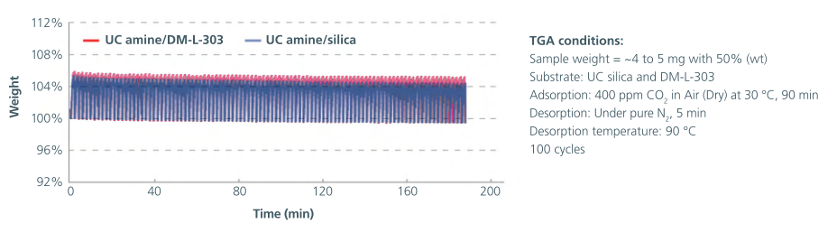
University of Cincinnati testing demonstrated the stability and compatibility of SOLESPHERE silica with the amine formulation used in the study.
Higher CO₂ Adsorption Capacity at Direct Air Capture Concentrations
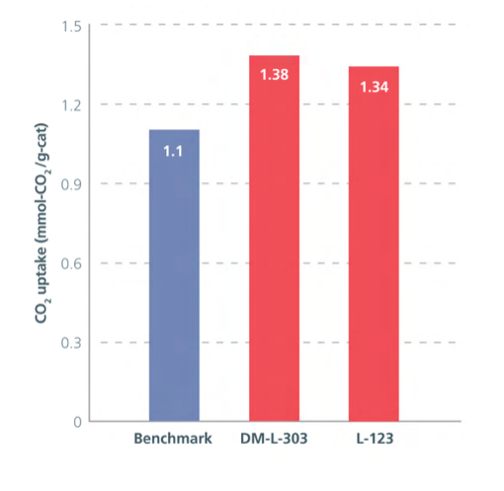
SOLESPHERE silica offers better CO₂ adsorption capacity, according to test results form the University of Cincinnati, using the same amine. It improved adsorption performance by 25% compared with the benchmark silica tested, especially at low concentrations such as 400 ppm, a concentration relevant to direct air capture from ambient air.
How Can Better Sorbents Improve Direct Air Capture Efficiency?
Carbon capture systems require significant energy to remove CO₂ from industrial emissions and ambient air. Solid sorbents that utilize SOLESPHERE silica particles can improve the efficiency of these systems, providing higher CO₂ adsorption capacity and requiring fewer carbon capture cycles to reduce energy consumption and operating costs, while supporting the scale up of DAC systems.
For developers evaluating sorbent products for direct air capture, adsorption capacity is particularly important because atmospheric CO₂ is present at much lower concentrations than CO₂ in many industrial exhaust streams. Materials that effectively support amine loading and CO₂ adsorption at low concentrations can therefore play an important role in improving DAC system efficiency.
Looking for high-performance sorbent materials for direct air capture and other carbon capture applications? Click here to learn more about advanced SOLESPHERE grades or contact an AGC product expert.
Frequently Asked Questions About About Sorbent Products for Direct Air Capture
What are sorbent products for direct air capture?
Sorbent products for direct air capture are materials designed to capture CO₂ directly from ambient air. Solid sorbents can use porous support materials treated with CO₂-binding compounds such as amines. Mesoporous silica provides a high-surface-area support structure that can facilitate amine loading and CO₂ adsorption.
Why is mesoporous silica used in direct air capture sorbents?
Mesoporous silica can provide the pore structure, stability and amine-loading capacity needed for efficient CO₂ adsorption. SOLESPHERE mesoporous silica also demonstrates thermal and mechanical stability for carbon capture applications.
Why is CO₂ adsorption at 400 ppm important for direct air capture?
Direct air capture must remove CO₂ from ambient air, where concentrations are much lower than in many industrial emissions. In University of Cincinnati testing at 400 ppm CO₂, amine-treated SOLESPHERE silica demonstrated stronger adsorption performance than the benchmark silica tested.
What is carbon capture efficiency?
Carbon capture efficiency measures how much CO₂ a system captures relative to the energy/cost required for adsorption and regeneration.
How can carbon capture efficiency be improved?
Carbon capture efficiency can be improved by increasing CO₂ adsorption capacity, optimizing amine loading, improving pore structure and gas diffusion, and reducing the energy required to regenerate the sorbent.
How did SOLESPHERE perform compared with benchmark silica?
In University of Cincinnati testing using the same amine treatment, SOLESPHERE silica improved adsorption performance by 25% compared with the benchmark silica.