 English

Reading Time: 3 minutes
This post explores how FEVE resins have contributed to metallic architectural coatings, which continue to grow in popularity because they provide buildings with a distinctive, premium appearance. It’s always been a challenge to achieve brilliant metallic finishes without sacrificing long-term durability. Traditional fluoropolymer powder coatings often require processing temperatures that aluminum architectural substrates cannot tolerate, making it difficult to combine metallic aesthetics with exceptional weatherability.
Architects and coating formulators continually seek materials that deliver long-term durability while maintaining brilliant appearance. FEVE resins enable architectural coatings to retain gloss, color, metallic effects, and corrosion resistance for decades, even in harsh outdoor environments.
To address this challenge, AGC developed a new approach by blending FEVE resin with super-durable polyester resin to produce metallic powder coatings that are both durable and cost-effective. The new blended resin:
- Protects metallic pigments from processing damage
- Produce brighter, more uniform metallic finishes
- Eliminate the need for solvents
- Reduce material costs
- Deliver exceptional UV resistance and weatherability
- Maintain gloss and color for decades
- Provide outstanding corrosion resistance
What Is FEVE Resin?
Fluoroethylene vinyl ether (FEVE) resin is a solvent-soluble fluoropolymer used in high-performance architectural coatings. It provides exceptional UV resistance, weatherability, color retention, chemical resistance, and corrosion protection, making it one of the most durable resin technologies available for long-term exterior applications.
Why Conventional Fluoropolymer Powder Coatings Have Limitations
Fluoropolymers have superior chemical, corrosion and thermal resistance. They also have excellent weathering, surface and aesthetic properties when applied as coatings on different substrates. Typical examples include:
- PTFE (aqueous dispersions of polytetrafluoroethylene)
- FEP (tetrafluoroethylene/hexafluoropropylene copolymers)
- PFA (tetrafluoroethylene/perfluoroalkyl vinyl ether copolymers) used in nonstick and anticorrosion applications
- PVDF (polyvinylidene fluoride) used in liquid paints for architectural applications
However, these fluoropolymers are not necessarily suitable for use in powder coatings in architectural applications. Although fluoropolymers such as PTFE, FEP, PFA, and PVDF provide excellent chemical and weather resistance, they are not always suitable for architectural powder coatings because of processing limitations.
FEVE resin overcomes these limitations through its unique molecular structure. It combines exceptional UV resistance, chemical stability, pigment compatibility, and adhesion while allowing cross-linking with other resins to improve coating performance.
Blending to achieve metallic effects
For the study, AGC blended 30% FEVE resin powder and 70% super-durable polyester powder using a four-step process (see figure below). They added aluminum pigments to the blends after the extrusion process, then electrostatically coated the substrate with the blend, and finally cured it.
Unlike conventional powder coatings, the blended system creates a layered coating structure that protects metallic pigments while preserving their reflective appearance. This produces brighter metallic finishes without compromising long-term durability.

Using this process, the polyester resin adheres to the structure, while the FEVE resin migrates to the surface of the coating. The metallic flakes stay sandwiched between the polyester and FEVE layers. The FEVE resin provides a clear layer that protects both the polyester and metallic pigments from shearing, providing increased durability.
Why FEVE Resin Delivers Superior Long-Term Performance
LUMIFLON® FEVE resins were developed in 1982 by Asahi Glass. FEVE is a thermoset polymer that can be processed through typical thermoset powder coating equipment. No liquid nitrogen is needed during the process, which makes it more process forgiving.
The alternating arrangement of fluoroethylene and vinyl ether units gives FEVE resin its unique combination of UV resistance, transparency, gloss retention, flexibility, and pigment compatibility. It also allows functional groups to be incorporated for cross-linking, further improving coating performance.
Applications for FEVE Resin Architectural Coatings
FEVE resin/polyester blends are ideal for applications requiring exceptional weatherability and long-term appearance retention, including:
- Curtain walls
- Aluminum composite panels
- Metal roofing
- Building façades
- Window frames
- Architectural trim
- Decorative metal panels
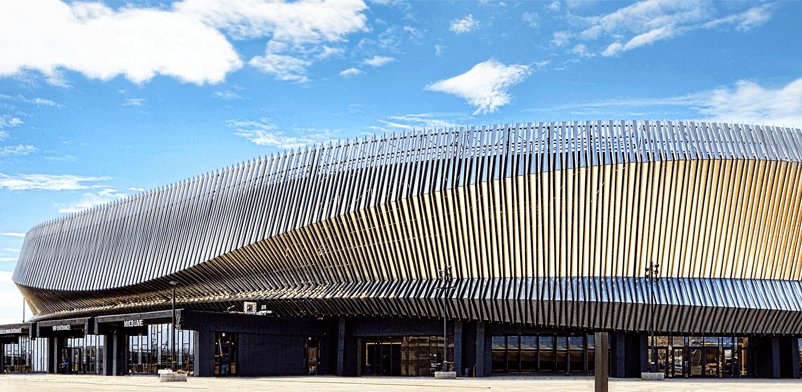
- Stadiums
- Airports
Why Architects Specify FEVE Resin
- Outstanding UV resistance
- Superior gloss retention
- Excellent color retention
- Metallic appearance lasts longer
- Outstanding corrosion protection
- Lower lifecycle maintenance costs
- Environmentally friendly powder coating technology
- No solvent emissions during application
By combining FEVE resin with super-durable polyester, manufacturers can produce metallic architectural coatings that deliver exceptional appearance, long-term weatherability, corrosion resistance, and lower lifecycle costs. This technology provides architects and building owners with an attractive, durable solution for demanding exterior environments. To learn more about the process, click here.
Frequently Asked Questions about FEVE Resins
What is FEVE resin?
Why is FEVE resin used in architectural coatings?
Can FEVE resin be used in powder coatings?
How long do FEVE resin coatings last?
What are the advantages of FEVE resin compared with polyester?