 English

Reading Time: 4 minutes
Many products we use every day are made from nonwoven fabrics, including home furnishings, disposable medical products, and automotive parts and interiors. Applying a water repellent for fabric helps these materials resist moisture, maintain durability, stay cleaner and provide a stronger barrier against water, oil and other fluids. Nonwoven fabrics can be treated with moisture repellents as rolled goods. This makes them more durable, able to stay dry longer, easier to clean, and better at providing a barrier against harmful fluids.
What is a Water Repellent for Fabric?
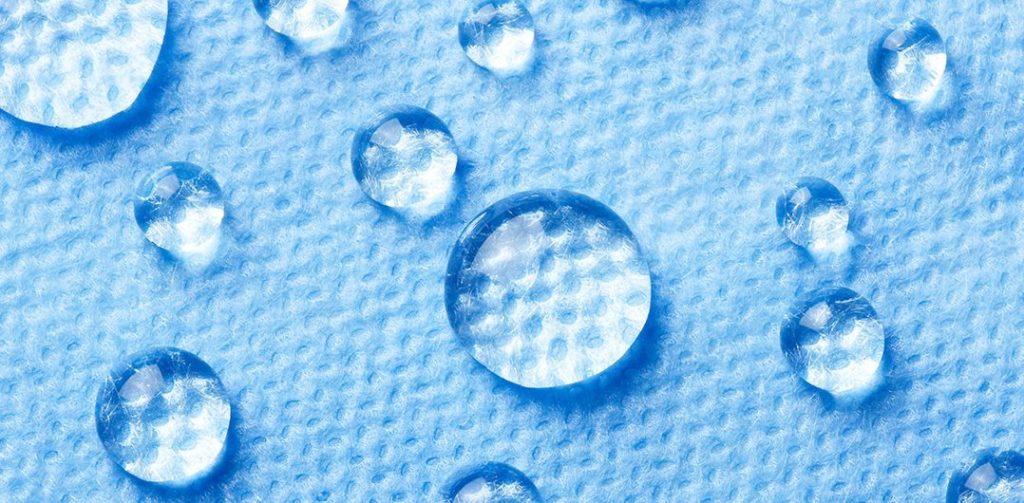
A water repellent for fabric is a coating or treatment that creates a protective barrier on textile fibers, causing water and other liquids to bead up and roll off instead of soaking into the material. Depending on the formulation, advanced fabric repellents can also resist oils, stains and chemicals while preserving breathability and flexibility.
For manufacturers of nonwoven textiles, selecting the right water repellent depends on the end-use application, durability requirements and regulatory considerations.
What are Nonwoven Fabrics?
Traditional fabrics are woven or knitted. Nonwoven fabrics are engineered as sheet or web structures, bonded together by entangling fiber or filaments through mechanical, thermal or chemical means. These fabrics can be designed for single-use or limited-life applications, but they can also be durable enough to provide a long service life. Not only can they be engineered with various strengths, they can also mimic the texture and appearance of woven textiles.
Because nonwoven fabrics are used in such a wide range of products and apparel, it’s important for mills and manufacturers to select the the best water repellent for fabric based on their specific application.
Types of Non-Fluorinated Water Repellent Coatings
Non-fluorinated coatings offer good moisture resistance for nonwoven fabrics, protecting them from water, oil, and other contaminants. In recent years, adoption of non-fluorinated coatings has accelerated as manufacturers seek high-performance water repellents for fabric that comply with evolving environmental regulations.
There are five primary types of non-fluorinated coatings used to create water-repellent fabrics. Each offers unique advantages and limitations.
Silicone-Based Coatings
Silicone-based coatings are are commonly used as water repellents for fabric because their low surface energy prevents water from penetrating textile fibers. However, they offer little resistance to oils or solvents and generally provide limited stain resistance and long-term durability. As a result, they may not be the best choice for demanding applications such as medical garments.
Urethane-Based Coatings
Urethane-based coatings provide excellent water resistance by forming a closed-cell barrier that prevents moisture penetration while maintaining softness and breathability. However, prolonged ultraviolet exposure can degrade these coatings over time.
Paraffin-Type Coatings
Paraffin-type coatings are derived from petroleum, coal or oil shale and provide an economical water repellent for fabric, particularly for nonwoven and synthetic materials. They fill the spaces between fibers to block water penetration. Although effective against water, they provide little protection from oils or isopropyl alcohol and are generally considered less sustainable than newer non-fluorinated alternatives.
Acrylic-Based Coatings
Acrylic-based coatings provide a strong barrier against water and stains while maintaining fabric flexibility. They can be applied to many types of nonwoven fabrics, from filtration media to medical disposables. They also contain fewer VOCs than urethane-based coatings, reducing potential environmental and health concerns..
AGC Chemicals Americas designed FibraLAST® acrylic-based coatings as a high-performance water repellent for fabric that protects both woven and nonwoven materials. FibraLAST also provides excellent resistance to isopropyl alcohol, making it well suited for medical disposables and industrial textiles. The coating creates a microscopically rough surface that causes liquids to bead up for easier cleanup while maintaining fabric performance. Typical applications include upholstery, uniforms, filtration media and automotive textiles.
How Do You Choose the Best Water Repellent for Fabric?
Selecting the best non-fluorinated water repellnet for nonwoven fabric can be challenging because each formula interacts differently with various fabric types. To overcome these challenges, manufacturers and mills should collaborate closely with their chemical suppliers to determine the optimal coating for each specific application. Key performance tests include:
- Water/Oil Repellency Test: Measures how effectively the fabric repels water and oil.
- Hydrostatic Pressure Test: Determines the force and time required for a liquid, usually water, to pass through the fabric.
- Surface Resistivity Test: Measures how much static charge can be applied by measuring electrical resistance across the fabric surface.
- Static Decay Test – Measures the time required for an electrical charge to dissipate from the fabric.
- Stain Release Test: Evaluates the fabric’s ability to release oily stains during laundering.
AGC test labs use advanced equipment to replicate commercial coating processes and evaluate performance under real-world conditions. Through collaborative testing, AGC helps mills and manufacturers select the best water repellent for fabric based on application requirements, durability expectations and regulatory compliance.
Frequently Asked Questions about Water Repellents for Fabrics
What is the best water repellent for fabric?
The best water repellent depends on the fabric type and application. Acrylic-based coatings often provide an excellent balance of water repellency, oil resistance, durability and environmental performance for nonwoven textiles.
What is the difference between water-resistant and water-repellent fabric?
Water-resistant fabrics slow moisture penetration, while water-repellent fabrics use specialized surface treatments that cause water to bead up and roll off before it can soak into the fibers.
Can non-fluorinated coatings repel both water and oil?
Yes. Some advanced acrylic-based non-fluorinated coatings, such as AGC’s FibraLAST®, are engineered to repel both water and oils while maintaining flexibility and durability.
Which industries use water-repellent nonwoven fabrics?
Water-repellent nonwoven fabrics are commonly used in:
- Medical disposables
- Automotive interiors
- Upholstery
- Industrial textiles
- Filtration media
- Protective apparel
- Hygiene products
Ready to upgrade your textiles with a sustainable coating? Download this product sheet to learn how FibraLAST coatings repel oil and water from industrial textiles.